
NAB Show
Trends and Topics: Business Strategy.
The Great Media Reshuffling: In the Battle for Scale, What Actually Creates Value?
The media business has spent years chasing scale. Bigger content libraries, broader distribution and headline-making mergers have promised a stronger position in an increasingly fragmented market. Yet a decade of consolidation has made clear that scale alone is no guarantee of shareholder value.
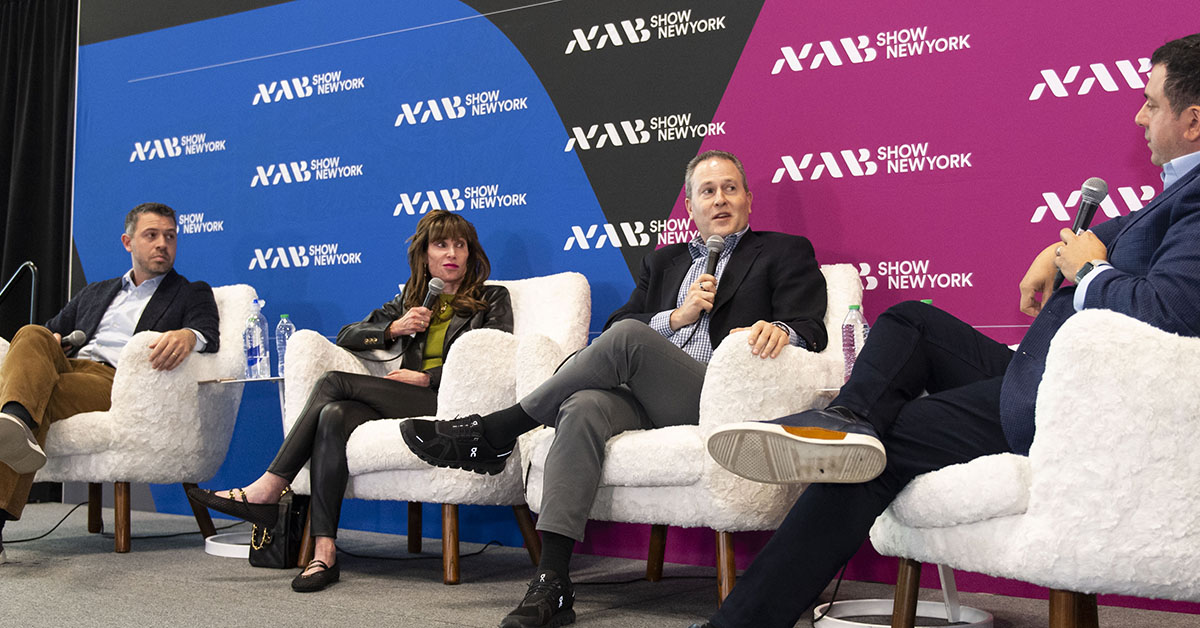
At NAB Show New York 2026, the session “The Great Media Reshuffling: Consolidation, Spin-Offs and the Battle for Scale” examined what comes next as media companies contend with mature streaming markets, pressure on traditional business models and competition for increasingly fragmented attention.
The panel brought three distinct views of that reshuffling: Eric Menell, global head of media and communications investment banking at J.P. Morgan; Jessica Reif Ehrlich, managing director, media and entertainment, U.S. equity research at BofA Securities Inc.; and Aaron Sobel, partner at Apollo Global Management.
Moderated by Alex Sherman, media and sports reporter at CNBC, the conversation examined consolidation, streaming economics, broadcast, sports and AI, and what actually creates value as the industry’s business models continue to shift.
The through line was clear: The next phase of media will not reward size for size’s sake. The assets, economics and audience relationships inside that scale matter just as much.
Key Takeaways:
- Premium IP is becoming an even more important differentiator as audiences fragment and streaming services compete for engagement.
- Consolidation may be inevitable for parts of the traditional media business, but creating value requires more than combining companies and cutting costs.
- Broadcast still has strategic value, particularly through its reach, local news and ability to deliver sports to large audiences.
- Sports remains unusually attractive capital, thanks to scarcity, live engagement and demand from an expanding universe of wealthy buyers.
- AI could materially improve media economics, but the panel cautioned against confusing the value of using technology with the value of owning technology companies.
In a Fragmented Market, Premium IP Gets Pricier
Sherman opened with a deceptively simple question: What should media companies be trying to own?
For Menell, the answer starts with premium content. He argued that valuable film and television libraries are difficult to build and can be undervalued by markets more enamored with high-growth businesses. At the same time, an abundance of streaming services makes differentiation increasingly important.
“Premium always differentiates,” Menell said, arguing that streaming companies benefit from owning more premium, high-quality content.
Sobel pushed the idea further. With consumer attention scattered across more platforms and experiences, distribution alone is not enough.
“I think you’re also seeing a pendulum shift where IP matters a lot more than distribution,” Sobel said. “Netflix is now the incumbent, ironically, and with attention being so fragmented, you need really valuable premium IP to actually work.”
That distinction matters for media leaders. Scale is useful when it concentrates assets audiences actively seek out, but a larger collection of undifferentiated content does not necessarily create the same strategic advantage. In a market replete in choice, scarcity can be more defensible than volume.
I think you’re also seeing a pendulum shift where IP matters a lot more than distribution.
— Aaron Sobel, Partner, Apollo Global Management
Consolidation Is Not a Strategy Unless the Economics Work
Citing a series of major legacy media consolidations over the past decade, Sherman said the media industry does not have a strong track record of consolidations delivering shareholder value.
The panel did not dispute that several large mergers have struggled to produce the shareholder value initially envisioned. But they argued against treating every deal as evidence that consolidation itself is broken.
The fundamental problem is how the industry’s underlying economics have changed. Menell contrasted the lucrative traditional pay-TV model with streaming, where consumers pay for individual services rather than supporting a bundle in which different audiences effectively subsidized programming for one another.
“The linear business model is one of the world’s greatest business models,” Menell said. “The streaming business model is not good.”
Reif Ehrlich looked to the music business as an example of an industry that endured its own disruptive transition before finding a more attractive economic model.
“At some point, I don’t know when that is, we will come out the other side, and economics will become, I think, more attractive, and business models will evolve,” she said.
The important word is “evolve.” Cost reductions can improve margins, but they cannot indefinitely substitute for growth. The panel repeatedly cited asset mix, revenue growth, engagement and operating execution as the factors that could ultimately change how investors value media companies.
Don’t Count Out Broadcast
In broadcast, Sobel argued that further consolidation is necessary, but he sees value the market may be missing.
“I do believe that there’s more of a bull case for stations than the market gives credit for,” he said.
Reach is part of the equation. Sobel pointed to sports and leagues’ interest in broadcast distribution, while also arguing that local news continues to create value for station groups.
“The ways you can create value is really good local news,” he said, noting that strong local news can support negotiations with distributors.
The industry’s reshuffling does not automatically mean every legacy asset becomes less relevant. Assets that deliver scarce capabilities — including mass reach, local connection or must-see programming — can still occupy strategically important positions in a changing ecosystem.
Sports Plays by Different Rules
If much of traditional media is wrestling with questions of scale and growth, sports is a different game entirely.
The panel explored why teams and leagues continue to attract capital even as valuations climb. Menell described the choice facing investors who want exposure to sports: take a small position in a marquee franchise or control a less expensive team, with very different risks and potential returns. He also identified several characteristics that make the category unusual.
“A lot of people look at sports now and say it’s AI proof,” Menell said. “There’s real scarcity value.”
Event sports values may continue rising because of scarcity, recent rates of appreciation should not simply be projected forever, Sobel warned.
“Growth will inevitably slow, but it should still grow because of scarcity value,” he said.
The same dynamics are reshaping sports media rights. Leagues increasingly must balance revenue against reach as broadcast, streaming and technology platforms compete for packages. The mix of linear and digital distribution of major sports, however, is evidence that this is rarely an either-or decision.
Media companies chasing technology has always been a failed strategy.
— Eric Menell, Global Head, Media and Communications Investment Banking, J.P. Morgan
AI Is a Tool, Not a Corporate Identity
Across filmmaking — including previsualization, preproduction and, eventually, post-production and production — artificial intelligence has the potential to reduce costs and accelerate processes, Sobel said. But it will not replace creative talent.
“It’s another tool, and I think it’s going to add a lot of value,” Sobel said.
But the speakers drew a sharp line between adopting technology and attempting to become a technology company. Reif Ehrlich said that media businesses do not necessarily need to own AI technology to benefit from it.
“They can rent it. They can license it,” she said.
Menell put the warning more bluntly: “Media companies chasing technology has always been a failed strategy.”
Technology can make content development, production and marketing more efficient, but that does not stop the core business of creation, ownership, distribution and monetization of experiences audiences value.
The Next Reshuffling Will Be About Value, Not Just Size
The great media reshuffling is far from finished. More consolidation may come, business models will continue to evolve, sports will keep attracting capital and AI will change how content gets made.
With these changes, a more demanding definition of scale is emerging. Beyond simply getting bigger, media companies will need to assemble differentiated assets, durable audience relationships and economics capable of producing sustainable growth.
Watch the full session recording from NAB Show New York 2026, “The Great Media Reshuffling: Consolidation, Spin-Offs and the Battle for Scale.”
Thank you for attending NAB Show New York 2026.
We look forward to seeing next year!
September 29-30, 2027 | Javits Center, New York, NY