
NAB Show
Trends and Topics: Technology.
The Clock Behind the Content
PTP is now embedded in gear across broadcast, live production and pro AV, often in systems no one thinks of as timing-dependent. However, what it does, where it turns up, and understanding why has become part of the job.
Precision Time Protocol (PTP) has quietly become a requirement for a growing share of broadcast, live production and pro AV equipment, including gear that works perfectly well without anyone ever opening a timing menu. At NAB Show New York 2026, the Society of Motion Picture Picture and Television Engineers (SMPTE) is devoting a full day of training to it, and for good reason: it’s one of the few subjects where getting it right is something the audience can literally hear.
Everything Runs on One Clock
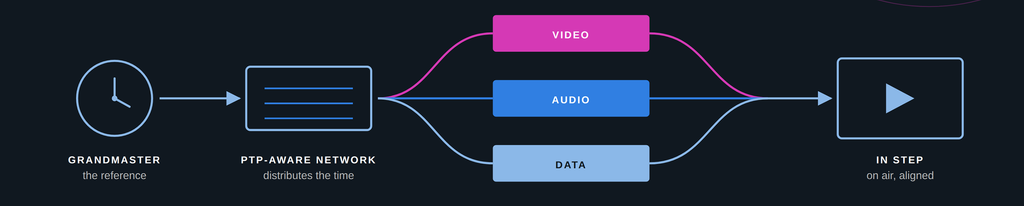
In the old SDI world, picture and sound traveled down one cable and arrived together because they were never apart. ST 2110 splits them into separate streams that take their own routes across a network, so something must reassemble them at the far end at exactly the right moment.
That something is a shared sense of time. One device on the network — the grandmaster — holds the reference, and everything else constantly checks itself against it and nudges its own clock to match.
ST 2110 Splits Streams That Must Be Reassembled
“Devices use PTP to synchronize their local clocks to a common reference clock,” says Douglas Gillette, an independent engineer, SMPTE and AIMS member, and producer of the upcoming timing bootcamp.
PTP itself is an IEEE standard, written for industry at large rather than for television. What adapts it to media is SMPTE ST 2059: an operating profile tuned to media synchronization, plus the rules for aligning signals to a common epoch. SMPTE wrote both, and ST 2110 alongside them.
Those standards are still moving. Leigh Whitcomb of Meinberg, a SMPTE fellow who co-chairs the committee behind them, is giving an update at NAB Show New York 2026 on where ST 2059 stands and recent work on PTP monitoring and interoperability.
PTP Escaped the Broadcast Facility
PTP started as an infrastructure concern for big IP broadcast installations, but it has spread well past them. Dante, Q-SYS, RAVENNA, AES67 and IPMX all lean on it.
“There are thousands of distinct Dante-capable products that require PTP,” Gillette says. Anything built to the AES67 audio standard needs it too, and the AIMS Alliance certified its first 48 IPMX products in February this year and 14 more in September.
So the useful question isn’t whether PTP is in your building. It’s whether you know where it is, which box is the reference, and which one takes over when that box hands off.
The Signal Can Arrive and Still Be Wrong
“Receiving the media, however, does not necessarily mean the timing is right,” Gillette says.
That one line covers an enormous amount of troubleshooting. Audio and video can keep arriving while synchronization is quietly failing, or arrive intact but too late to be any use. What the control room sees looks like a media fault, and it isn’t one.
“Engineers, therefore, need to distinguish between problems with the media and problems with timing,” Gillette says.
Redundancy adds a wrinkle: a facility running duplicate streams across two networks may take its timing from both, and a mismatch shows itself at failover — exactly the moment worth checking in advance.
When the Right Answer Is No PTP at All
Knowing where PTP stops is just as useful. “Not every IP-based media system requires PTP,” Gillette says.
NDI, SRT and RIST don’t depend on it; IPMX can run with or without it. And when PTP is the answer, whoever writes the specification still has to decide whether that reference belongs in a dedicated clock or in a switch that can take the role.
The Part You Can’t Get From a Spec Sheet
The point of open standards like ST 2110 and AES67 is that equipment from competing manufacturers works together. The hard problems, then, are never about one box on its own but about six boxes from six companies behaving at once on a show day. No single manufacturer can document that.
“Some find PTP intimidating,” Gillette says. “That concern is reasonable because severe audio and video problems can occur if a device’s local clock loses synchronization with the common reference clock.”
Some find PTP intimidating. That concern is reasonable because severe audio and video problems can occur if a device’s local clock loses synchronization with the common reference clock.
— Douglas Gillette, independent engineer, SMPTE and AIMS member, producer SMPTE timing bootcamp
The Fix Is Other People
What breaks the logjam is a room full of people who’ve hit the same walls. SMPTE Bootcamp: Precision Timing for ST 2110 runs all day on Wednesday, October 21, bringing together engineers from clock makers, switch vendors, audio platforms and production facilities.
“Many participating companies are competitors, but PTP matters to them all,” Gillette says.
You leave able to explain how timing moves through a facility, set up and verify a grandmaster and the clocks beneath it, spot the failure modes early, and know what to ask of a vendor. It’s designed for newcomers and veterans alike.
The day runs from fundamentals through network design, verification, networked audio and deployment practice. Speakers come from Telestream, Arista Networks, Meinberg, Audinate, Leader Electronics, NETGEAR and Lawo. Registration is open now.
Whether or not you make it to the bootcamp, the clock is doing more work in your facility than it used to.
As Gillette says: “PTP becomes easier to understand when engineers can ask questions and learn from others who have faced the same challenges.”
Nobody works this out alone, and nobody has to.
Join Us at SMPTE Bootcamp: Precision Timing for ST 2110
October 21, 2026
Javits Center | New York, NY
Explore both the precision timing systems that keep distributed media in sync and the foundational network mechanics that carry audio and video across IP infrastructure in full-day or half-day training.